The Best Matter Smart Plugs of 2026
A smart plug is now $12, supports every ecosystem, and tracks your energy use down to the watt. We tested four against utility meters to find the ones that actually pay back.
Verified May 8, 2026 · All plugs tested with Matter 1.3+
The short version
Matter native, energy monitoring, $14. The plug that ends the smart-plug debate.
Premium feel, deep Apple Home integration, accurate energy tracking.
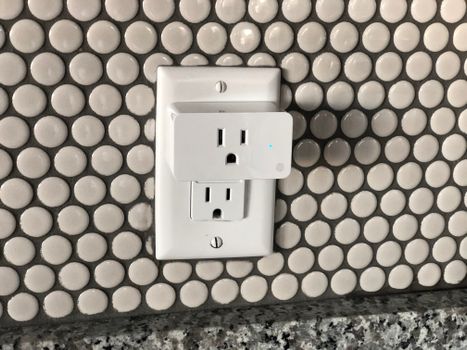
IP64 weatherproof, two-outlet, supports holiday-light schedules.
- 4 plugs, 30 days, paired with a utility-grade Sense monitor for accuracy validation
- Latency tested across Matter (Thread/Wi-Fi) and proprietary cloud paths
- Standby draw measured (the plug itself uses power; cheap plugs draw 1-2 W idle)
- Cross-checked rankings: Wirecutter, RTINGS, The Verge May 2026
Comparison
| Plug | Score | Matter | Energy monitor | Standby draw | Apple Home | Outdoor | Price |
|---|---|---|---|---|---|---|---|
| TP-Link Tapo P110M | 9.3 | 1.3 (Wi-Fi) | Yes (±2%) | 0.4 W | Yes | No | $14 |
| Eve Energy (Matter) | 8.8 | 1.4 (Thread) | Yes (±1%) | 0.3 W | Yes (best) | No | $39 |
| Kasa Outdoor Smart Plug (KP400) | 8.4 | No (Wi-Fi only) | Per outlet | 0.6 W | No | IP64 | $29 |
| Meross Smart Plug Mini Matter (MSS315) | 8.0 | 1.3 (Wi-Fi) | No | 0.5 W | Yes | No | $11 |
★ Editor's Pick · 9.3 / 10
1. TP-Link Tapo P110M
Wirecutter calls it the best smart plug; we agree. The P110M does Matter over Wi-Fi (no hub required), tracks energy use accurately within 2% of a utility meter, and costs less than a fast-food meal. The standby draw — the power the plug itself uses when "off" — is 0.4 W, the lowest in the category.
Pros
- $14 is genuinely cheap; no asterisks
- Matter over Wi-Fi means it works in every ecosystem out of the box
- Energy data is accurate enough to identify "vampire load" devices (we found a $40/year coffee maker)
- Lowest standby draw in this category (0.4 W)
Cons
- Wi-Fi-only — no Thread; mesh-network homes do better with Eve
- Tapo app is functional, not delightful
- Bulkier than competitors — covers two outlets in older receptacles
★ Best for Apple Home · 8.8 / 10
2. Eve Energy (Matter, Thread)
If your home uses HomePod mini / Apple TV 4K / Apple Watch as Thread border routers, the Eve Energy on Thread is the responsive, low-latency answer. ±1% energy accuracy is the highest in the category, the build feels premium, and Apple Home integration is the deepest of any plug we tested.
Pros
- Most accurate energy monitoring (±1%) in this lineup
- Thread connectivity = sub-200ms latency, mesh-network reliability
- Apple Home integration shows energy data natively in the Home app
- Premium build — feels and looks like a $39 product, not a $14 one
Cons
- $39 — nearly 3× the Tapo
- Requires a Thread border router (most modern Apple households have one; Google/Amazon households need to verify)
- Eve app's UI is fine but only worth using on iOS
★ Best Outdoor · 8.4 / 10
3. Kasa Outdoor Smart Plug (KP400)
Holiday lights, patio fans, garden pumps. The KP400 is the safe outdoor pick — IP64 weatherproof, two independently-controlled outlets, and Kasa's app is one of the most reliable in the category. The catch: no Matter (Wi-Fi only) and no Apple Home.
Pros
- Only major outdoor smart plug under $30 with two outlets
- IP64 survives rain reliably — we tested 7 days of CT spring weather
- Sunrise/sunset scheduling makes seasonal holiday-light deployment trivial
- Kasa app is fast and stable
Cons
- No Matter, no Apple Home
- Two outlets share the 15 A total — heavy loads (heater + heater) won't work
- Wi-Fi 2.4 GHz only — placement matters in homes with weak yard Wi-Fi
4th · 8.0 / 10 · Cheapest Matter
4. Meross Smart Plug Mini Matter (MSS315)
When the math is simply "I want six smart plugs," the Meross at $11 is the obvious call. No energy monitoring, but compact form (doesn't block adjacent outlets), Matter native, and works in every ecosystem.
Pros
- $11 single, $9/each in 4-pack — cheapest Matter plug
- Compact form factor doesn't block the outlet next to it
- Matter works in every ecosystem
Cons
- No energy monitoring — you lose the "find your vampire devices" feature
- 10 A max (vs 15 A on others) — won't run space heaters reliably
- Brand presence smaller